For the bulk of my avid tennis-following (and occasionally playing) years, Rafa was the Roland Garros favourite for miles. No one else even came close. A few years back, things suddenly started to get a little iffy, as he got more and more injury-ridden. The clay court wins were no longer as resounding, the destruction of his opponent no longer as complete. Roland Garros started today, and while Nadal has recovered some of his previous clay court prowess, he isn’t quite the tournament favourite he used to be. For a die-hard fan like myself, watching his slow decline has been painful, to say the least. But seeing his perseverance, his dogged spirit, his sheer dedication to and respect for the sport through his losses has shown me the other, equally inspiring, side to him.
Today takes me back to another time I saw that side of him, a side that wasn’t easy to watch – his 2014 Australian Open Final against Stan Wawrinka. This seems like a good time to post something I wrote after that Final.
Today, I witnessed a display of perseverance, sportsmanship, and mental strength from one of the greatest athletes to grace the world of tennis. I always knew this was a part of him, it was something spectators witnessed every match. Today, however, I also witnessed another side of Rafa Nadal, defeat and resignation.
While watching Nadal play, my father once commented that you need to hit at least three winning shots to win a single point against Nadal; he doggedly pursues everything in a manner that must exhaust him and frustrate his opponent. He has used sheer determination and hard work to get where he is, from a weak serve and style of playing that dominated on only one surface to a career slam and consistent years on the top of the ATP rankings despite being injury-prone. Whatever the score, however many sets down he may be, you can never write him off until the match is over.
It was when I read his autobiography that I understood his philosophy – forget what has happened before this point, forget whether it’s a small point or a break of serve or even a match point, don’t be over-confident or under-confident; just play each point afresh, without any baggage. Wipe everything that has happened or will happen from your mind, and play the point. It’s a simple philosophy, really. Nothing revolutionary; no big secret. But this is what gives him his mental strength and that edge over others. This is what allows him to come back from seemingly impossible situations, to hold on despite the odds. This is what doesn’t let his opponents expect or assume victory against him until it is actually in their hands.
Today, the Rod Laver Arena saw an entirely different Rafa. Granted, Wawrinka was playing fantastic tennis, undoubtedly at a higher level than Nadal. Despite a weak performance, Nadal was keeping at it when he took a medical time out for back problems. When he returned, he was a shadow of the champion numerous grand slam finals had seen before. Barely able to serve, with serves 30 kpmh slower on average than in the first set, he had minimal movement on the court. He was letting points go that he would never, in proper form, have allowed to slip past him. He wasn’t even trying; it was a far cry from the Nadal who is usually chasing down every shot, from one corner of the court to the other.
Despite his obvious inability to play, he didn’t retire from the match, which a lesser player might have done. He wanted to finish the match, and give it his all, however much that was at the time. I would like to believe that he wanted Stan Wawrinka to be crowned champion because he won the match, not because Nadal retired hurt.
When he took his medical time out, momentum and form were definitely on Wawrinka’s side. The crowd felt he had done so in an effort to throw Wawrinka’s game off rather than for an actual medical need, evident in the boos and jeers he received upon returning to court. It was probably the first time he had been received in such a manner at his favourite tournament, but he didn’t let it affect him. By the end of the match, the crowd was squarely on his side. Cheers for Rafa reverberated through the stadium each time he did something as simple as hold serve.
During the presentation ceremony, as can be expected by anyone who has heard him speak after a defeat, he didn’t once mention his back injury. He was humble, thankful, and full of praise for Wawrinka. He isn’t one to hide behind excuses of injury after a loss, and he displayed that yet again. It was Wawrinka, in fact, who brought it up.
For Nadal’s fans and opponents, it must have been a humanizing experience to see the great Rafa Nadal reduced to such a condition. For Wawrinka, superior tennis at the right time allowed him to make history. For an ardent supporter like me, even though I can admit that Wawrinka might have won the match despite the injury, seeing Nadal like that was heart-breaking. As he apologized to the crowd for not being able to win, my heart went out to him. It is in these moments that you learn to appreciate him for his losses as much as his wins.
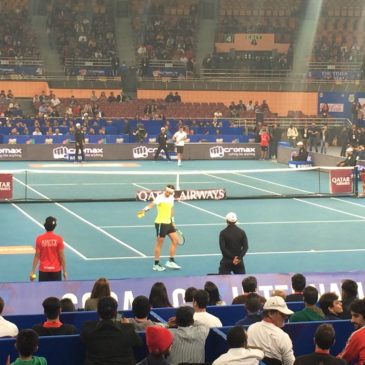
Excuse the picture quality, but it’s pretty much the closest I’ve gotten to the man himself
One thought on “The other Rafa”